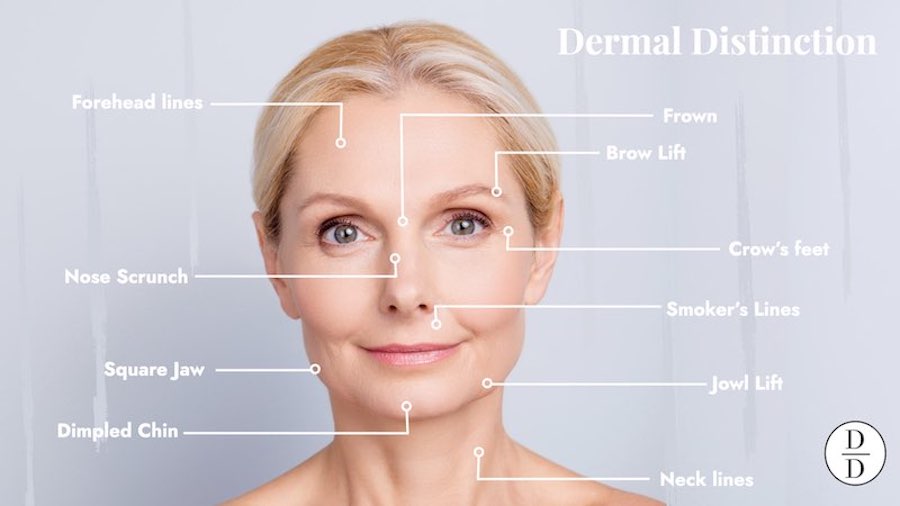

Facial shape & balance
We assess the relationship between facial width, length, projection and the upper, middle and lower thirds of the face.
Personalised assessment for facial lines, folds, volume loss, contour changes and the features that influence facial balance.
At Dermal Distinction in Balwyn North, we assess your individual anatomy, proportions, facial movement, skin and age-related changes before discussing whether treatment may be appropriate.
Rather than focusing on a single line or feature in isolation, we consider how areas such as the forehead, eyes, temples, cheeks, lips, chin and jawline relate to the face as a whole.
Facial aesthetics is about understanding how the different parts of your face work together.
Your consultation considers facial structure, movement, skin, proportions and the changes that occur over time. This helps us identify what may be contributing to your concern before discussing treatment options.
We assess the relationship between facial width, length, projection and the upper, middle and lower thirds of the face.
Facial expression and muscle activity can influence lines, brow position, smile dynamics and the way features change between rest and movement.
The underlying facial skeleton contributes to projection, contour and the support of the soft tissues above it.
We look at how facial fat and supporting tissues are distributed and whether these relationships have changed over time.
Pigmentation, texture, elasticity and fine lines can all contribute to how the face appears and may require a different treatment approach.
Natural facial asymmetry is normal. We identify differences between the two sides and consider them as part of any treatment plan.
A concern in one area can sometimes be influenced by a neighbouring feature. Looking at the whole face helps us avoid treating individual areas without understanding how they relate to one another.
Changes in the face occur across multiple tissue layers, which is why facial ageing should not be viewed as a single issue.
Facial ageing is more complex than simply “losing volume”.
Bone, fat compartments, muscles, ligaments and skin all change over time. These changes can alter facial contour, movement, support and the way light falls across the face.
Understanding which layers are contributing to what you see allows treatment planning to be more specific to your individual face.
The facial skeleton provides support for the tissues above it. Age-related structural changes can influence projection, contour and the overall shape of the face.
Fat is arranged in different compartments across the face. Changes in their volume and position can alter the cheeks, temples, under-eye area and lower face.
Facial muscles influence expression, lines and the position of features during movement. This is assessed dynamically, not only when the face is at rest.
Ligaments and other supporting structures contribute to where soft tissues sit and how different areas of the face relate to one another.
Changes in elasticity, texture, pigmentation and fine lines affect the overall appearance of the face and may require a different approach from structural concerns.
Two people can have a similar concern but for completely different anatomical reasons. Assessment helps identify what is actually changing before treatment is considered.
Changes in facial shape are not simply the result of skin becoming older or volume disappearing.
The appearance of the face is influenced by the underlying skeleton, facial fat, supporting tissues, muscles and skin. These structures can change at different rates and in different ways, altering facial proportions, contours and the transition between neighbouring features.
This is why two people of the same age may notice very different changes — and why assessment needs to look beyond the single area that first catches your attention.
Facial ageing is three-dimensional. Changes in one layer can influence how neighbouring areas appear.
Lines, folds, volume changes and changes in facial contour can occur across different areas of the face.
We assess the area that concerns you as well as the neighbouring structures that may be influencing its appearance. Treatment planning is based on your individual anatomy, facial proportions, skin, movement and clinical assessment.
Horizontal lines can become more visible with repeated facial movement and changes in the skin over time.
Repeated movement between the eyebrows can create vertical or angled lines that may remain visible at rest.
Expression lines, skin quality and the relationship between the brow, temple and cheek can all influence this area.
Loss of fullness through the temple can create a more concave contour between the forehead, outer eye and cheek.
The appearance beneath the eyes can be influenced by skin, underlying structure and the transition into the upper cheek.
Changes in cheek projection, width and soft tissue can influence the contour and balance of the midface.
These folds can become more noticeable as facial structure, soft tissues and skin change over time.
Lip shape, fine lines, surrounding skin and the relationship between the lips and lower face are assessed together.
Changes around the corners of the mouth can reflect movement, soft-tissue changes and the structure of the lower face.
Chin height, width, projection and surface contour can influence lower-face proportions and facial profile.
Jaw shape, soft tissue and the relationship between the jaw, chin and neck can influence how defined the lower face appears.
Skin quality, movement and the transition between the jawline and neck can all contribute to visible changes here.
Some concerns may be suitable for treatment following an individual consultation and clinical assessment. We will discuss your concerns, suitability, available treatment options, potential risks, expected outcomes, aftercare and costs before treatment is considered.
You do not need to arrive knowing which treatment you need.
Tell us what you have noticed, what has changed and what you would like to understand. We can then assess your face as a whole before discussing whether treatment is appropriate.
BOOK A CONSULTATIONWe discuss what you are noticing, what has changed and what you would like to achieve.
We consider facial structure, proportions, movement, skin, asymmetry and the relationships between features.
If treatment is suitable, we explain your options, limitations and an individual approach for your face.
The goal is not to treat every visible change. It is to understand your face first and recommend only what is appropriate for you.
You do not need to know which treatment you need before coming to see us.
Some patients notice lines or changes in facial movement. Others are concerned about facial shape, cheek support, skin quality or changes that have developed gradually over time.
Your consultation helps us identify what may be contributing to your concern and which areas of the face need to be considered together.
Facial ageing involves changes in skin, structure, soft tissue and facial proportions — not simply one isolated feature.
Different areas of the face change for different reasons. Bone structure, facial fat, supporting tissues, muscle activity and skin can all contribute to the changes you notice.
The temple can become more hollow as the underlying bone, fat and soft tissues change over time. This may create a more concave contour between the forehead, outer eye and upper cheek.
Because the temple forms part of the upper facial frame, changes here can also influence how the brow and cheek appear in relation to one another.
EXPLORE TEMPLE ASSESSMENT →Cheek shape is created by several layers, including bone, facial fat and supporting tissues. Changes across these structures can reduce projection or alter where fullness sits within the midface.
This can make the cheeks appear flatter and may also change the transition into the under-eye and lower face.
EXPLORE CHEEKS + FACIAL STRUCTURE →Nasolabial folds are the natural creases that run from the sides of the nose towards the corners of the mouth. Their appearance can become more noticeable as the skin, midface and supporting tissues change over time.
The fold itself is therefore not always the only area that needs to be considered during assessment.
EXPLORE FACIAL VOLUME + CONTOUR →Jawline contour reflects the relationship between the jaw bone, chin, facial soft tissues, skin and neck. Changes in these structures can gradually alter the definition and shape of the lower face.
This is why we assess the jawline together with the chin, cheeks and neck rather than looking at the jaw alone.
EXPLORE JAWLINE ASSESSMENT →Under-eye appearance can be influenced by underlying structure, soft-tissue volume, skin quality and the shape of the upper cheek.
A deeper transition between the lower eyelid and cheek can create shadowing, which may make the area appear hollow or darker even when skin pigmentation is not the primary cause.
EXPLORE UNDER-EYE ASSESSMENT →Facial volume does not simply disappear evenly. Facial fat is arranged in different compartments, and these can change in volume and position over time.
Combined with changes in bone, supporting tissues and skin, this can alter where the face appears fuller, flatter or less defined.
EXPLORE FACIAL VOLUME + PROPORTION →The lips and surrounding mouth area can change as the skin, soft tissues and underlying facial structures change with age. This may affect lip fullness, projection and border definition.
Fine lines and changes around the mouth can also influence how the lips appear, which is why we assess the surrounding lower face as well as the lips themselves.
EXPLORE LIP ASSESSMENT →Facial anatomy and ageing patterns vary from person to person. An individual consultation allows us to assess what is contributing to the changes you are noticing before discussing whether treatment may be appropriate.
Cosmetic medicine is not approached as a menu of individual treatments. We begin by understanding your concerns, medical history, facial anatomy and the changes you are noticing.
Relevant medical history, medications, previous procedures, current concerns and treatment goals are considered as part of your consultation.
We assess facial anatomy, proportions, movement, skin, symmetry and age-related changes, including how neighbouring areas influence one another.
Where treatment may be appropriate, we discuss suitable options, expected outcomes, limitations, potential risks, alternatives and costs before you decide how to proceed.
Appropriate aftercare, what to expect following treatment and follow-up arrangements are discussed as part of your individual treatment plan.
Treatment is only recommended where considered appropriate following consultation and clinical assessment.
At Dermal Distinction, your concerns, facial anatomy, medical history and treatment goals are considered before suitable options are discussed.